MANAGED SERVICES FOR IT, OT AND BUILDINGS ON ONE UNIFIED TECHNICAL FOUNDATION.
Vaiking is the operational foundation on which solution providers build their service portfolio. White-label capable · multi-tenant · ITSM-ready · SLA reporting directly from operational data
5 NEW CUSTOMERS THIS QUARTER. EVERY ENVIRONMENT DIFFERENT. ONBOARDING TAKES WEEKS. THAT IS NOT AN EFFICIENT, SCALABLE OPERATION.
01Onboarding takes weeks because every customer is configured individually
Every new customer brings a different infrastructure, different protocols, different SLA requirements. Configuration starts from scratch each time. Weeks until operations are running, weeks during which your technicians are tied up instead of onboarding more customers.
02SLA reporting runs three weeks in arrears, via spreadsheet
Sales promises full transparency. What is delivered is a monthly PDF report assembled from logs, ticketing system exports and a spreadsheet. Three weeks after the month it covers. That is not operational reporting, it is manual post-processing.
03Ticket created. Technician checks, acts, documents. Manually.
A ticket is created in the customer system. Your technician checks, acts, documents. Closes the ticket. Manually. This cycle happens daily, for every customer, without exception. Scaling without additional headcount is not possible this way.
04Scaling requires proportionally more headcount as long as everything is manual
Two new customers won. Monitoring volume is up 40%. Your capacity is not. Ticket reviews fall behind, onboarding slips, the next outage lands with a technician who is already tracking three other tenants.
YOUR BRAND. YOUR PROCESSES. VAIKING AS THE TECHNICAL FOUNDATION.
Vaiking handles monitoring, context-based assessment and automated response. Integration, service processes and customer relationships remain your focus.
White-label operations under your own brand
Vaiking can be operated entirely under your own brand. Configurable: logo, domain, dashboard header, report header, outbound emails. The end customer sees "Vaiking" or "dtm-group" nowhere. Your own pricing: you set your managed service price independently of Vaiking costs.
Tenant isolation and role model
Four-level role model: provider admin (all tenants), tenant admin (own environment), technician (operations, restricted), end customer (read-only). View rights and control rights independently configurable. Each tenant sees only their own data, actions and logs. Configuration templates enable reproducible rollout to new tenant environments.
ITSM integration and event-based handoff¹
PRE/EXEC/POST workflow is logged natively in the ticket: open, document, close. For external ITSM systems, configurable webhook endpoints: ServiceNow, Jira Service Management, Zendesk or custom systems. API key per tenant, scope restricted to that tenant. No cross-tenant access via API.
SLA reporting and billing logic
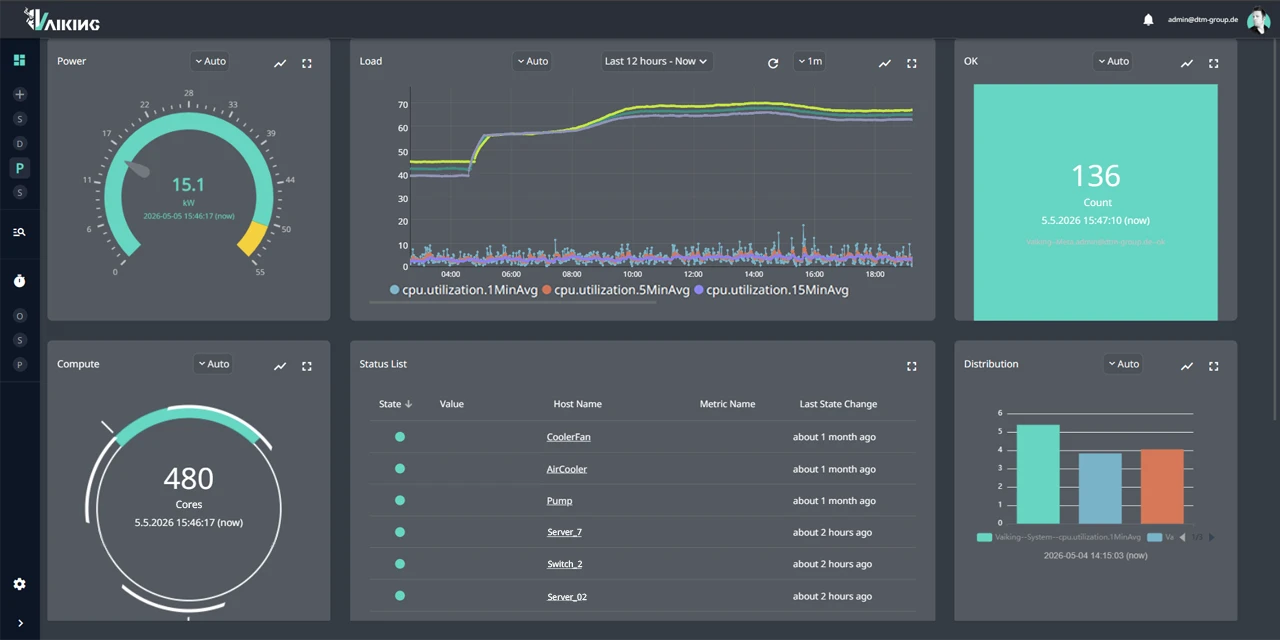
Billing basis is generated directly from running operations: configurable per tenant, per monitored device, per active rule. Availability, environmental parameters, response times, retrievable per tenant. Export via REST API for billing systems. No downstream collection process.
SLA evidence largely without additional manual effort.
¹ Pre-/post-condition checks: protected by utility model.
WHAT VAIKING CHANGES IN MANAGED SERVICE OPERATIONS.
Power load shift: Fully automated and documented
Rising load on a PDU is detected. The system assesses whether limit ranges are being reached.
Your technician is informed, not involved.
White-label rollout for a new customer: significantly faster with templates
A new managed service contract has been signed. The proven configuration is transferred to the new tenant environment: device classes, threshold logic, alerting rules, reporting templates. Autodiscovery identifies devices in the new environment automatically.
The customer sees a working dashboard under your brand, with an isolated tenant environment. Test operations validate data, alerts and actions before go-live. No six-week configuration effort.
Audit request for Tenant X: complete without manual assembly
An end customer requests the operational evidence for the last quarter: which actions were taken, when, with what outcome. Your team opens the audit log for that tenant.
All actions for the period are exportable per tenant. No manual assembly from multiple systems. No data from other tenants in the export.
Incident. Customer and MSP have different numbers.
After an incident, your customer requests the SLA evidence. Their monitoring data and your monthly PDF report show different availability figures. Your report is based on a log export and a spreadsheet. Completed three weeks after the month. Which number is correct? The customer conversation gets uncomfortable.
Every customer sees their availability in real time. The same data layer you report from.
WHAT EACH MODULE SOLVES IN YOUR OPERATION.
Monitoring
- All tenants on one system with strict data separation
- SLA-relevant states visible in real time for all customers
- White-label presentation under your own brand
Automatisierungs-Modul
- Automated first response per tenant, individually configurable
- ITSM integration: ticket opens, measure runs, ticket closes
KI-Modul
- Anomaly detection across all tenants without data leaks between customers
- Reduce alert noise without per-tenant threshold maintenance
30 MINUTEN. WE ASSESS HOW VAIKING FITS YOUR SERVICE PORTFOLIO.
IT, OT or buildings, or all three: we show you which managed service scenarios you can offer immediately with Vaiking as the foundation.