TENANT ISOLATION, ENERGY BILLING AND OPERATIONS: ONE SYSTEM.
Vaiking connects building management, IT monitoring and energy metering for colocation operators. Strict tenant isolation. Operator view and customer view clearly separated, without two parallel systems.

MANY DATA SOURCES. CONFLICTING STATES. AN OPERATION THAT STILL HAS TO RUN.
01Conflicting systems
A cooling fault in hall 2 affects customers A, B and C simultaneously, each with their own SLA and their own escalation path. Your BMS shows the alarm. Your DCIM shows rack occupancy. Your IT monitoring shows server failures. Which system is right, and which three contacts need to be notified in the next 15 minutes? No single system can answer that.
02Tenant isolation without a unified foundation
Tenant B finds a status notification in their dashboard that doesn't belong to their racks. Wrong group mapping, a bad update, or a manual configuration error. In practice: data incident. Contract breach. A customer conversation you couldn't prepare for. Tenant isolation is not a configuration detail, it is an operational obligation that no update can break.
03Energy billing based on estimates
End of month: energy data export from three systems, manual allocation at rack level, estimates where measurement points are missing. The result: customer queries, correction rounds in the ticketing system, conversations instead of invoices. Accurate billing does not happen at month end, it comes from the running operation.
04Regulatory reporting under time pressure
The compliance request arrives on Tuesday. Deadline is Friday. Your data lives in three systems, two of which have no export API. Answering this request ties up significant operational capacity at short notice. Not because the data is missing, but because no system consolidates it in the required form.
OPERATOR VIEW AND TENANT VIEW. WITHOUT SYSTEM BREAKS.
Vaiking consolidates energy flows, environmental values and IT metrics in a shared data layer. Strict tenant isolation: granular, role-based, fully audited.
Separate views on a shared foundation
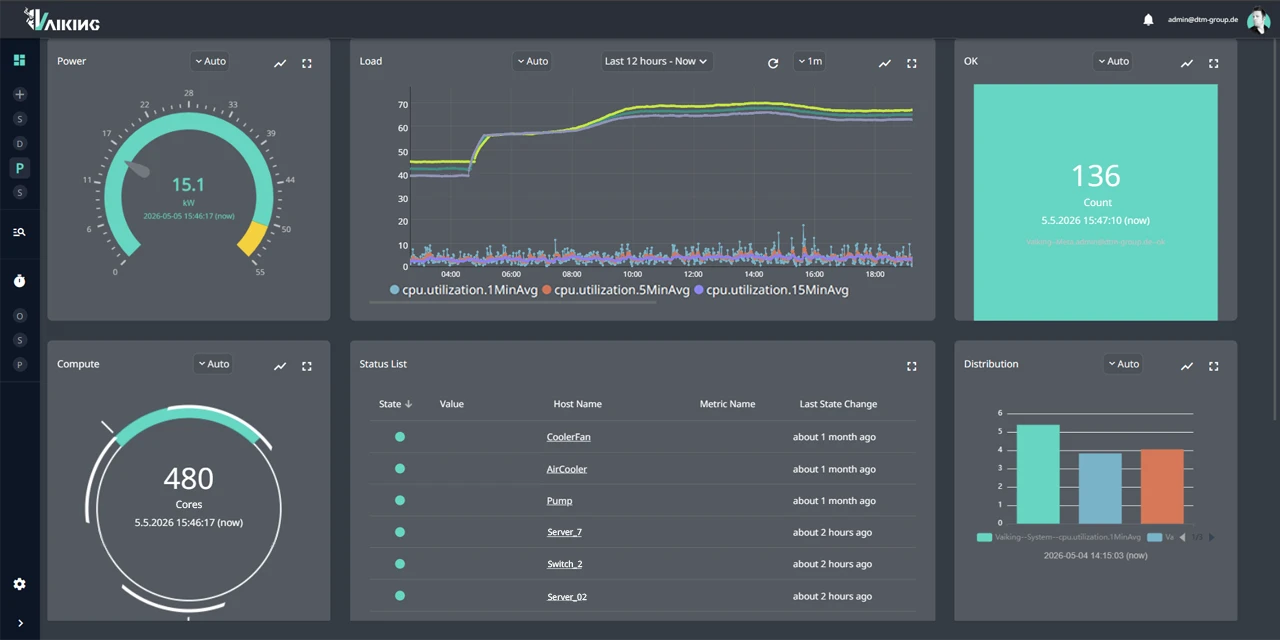
Operators see consolidated energy flows, capacity utilisation and environmental data across all sites. Tenants see only their own power consumption at rack or cage level, their own environmental values, their own IT metrics. Access rights are assigned at user and group level. View rights and control rights are independently configurable.
Energy metering without estimates
Power consumption is continuously recorded at rack, cage or tenant level. The billing basis is generated from the running operation. Readings are retrievable per tenant and exportable via REST API for billing systems. No manual allocation, no approximations.
Granular metering without estimates. No billing disputes with customers.
Automation with control¹
Every automated action runs through three phases. Automations can be restricted or disabled per tenant. All actions are fully logged, traceable for operations, the customer and auditors. The log is exportable per tenant.
- PRE: Check of current situation (redundancy, maintenance window, data consistency)
- EXEC: Execution of the defined action (e.g. PDU reset)
- POST: Validation that the affected system is reachable again
EnEfG and CSRD without separate data collection
PUE calculation, IT load share and ESG metrics are derived directly from operational monitoring. Differentiated tracking of IT load and infrastructure consumption (cooling, distribution) is built into the data layer, not added as a downstream reporting step.
¹ Pre-/post-condition checks: protected by utility model.
WHAT VAIKING CHANGES IN COLOCATION OPERATIONS.
Simultaneous fault: three customers, three escalation paths
Cooling alarm in hall 2. Hardware or climate issue unclear. Three customers affected, each with their own SLA and contact. Vaiking shows immediately: which racks belong to which tenant, which thresholds apply per SLA, which escalation contacts are on file.
No manual search for contacts under time pressure. No tracking in Excel of who was notified when.
Energy billing without month-end exports from multiple systems
Power consumption is continuously recorded at rack and cage level, isolated per tenant. No export round from three systems at month end. The billing basis is permanently available, granular, tenant-isolated, retrievable at any time.
Tenant sees only their own consumption. Operator sees aggregated across all tenants. No data leak. Billing is generated directly from operations, not from a downstream estimate.
Prevent a data incident before Tenant B asks
Tenant A reports an outage. While you escalate, a request comes from Tenant B: they see status changes in their dashboard that don't belong to their racks. A configuration error introduced during an update. No data exfiltration, but a data protection conversation you don't want to have.
Vaiking enforces tenant isolation at the system level, not through configuration. Operators see a consolidated view. Tenants see only their own area.
CSRD reporting: one PUE value, one calculation basis
Quarter end. Your ESG manager needs IT load share, infrastructure consumption and PUE for three sites. Your BMS and your DCIM show two different PUE values. Which figure you give the auditor is not just a reporting question, it is a question of defensible evidence. All data in Vaiking comes from a shared layer. One PUE value. One calculation basis. No dispute.
Export to structured formats or transfer to BI systems via the fully documented REST API.
WHAT EACH MODULE SOLVES IN YOUR OPERATION.
Monitoring
- Tenant-specific energy metering without estimates
- Consolidated overall view with strict tenant isolation
- Reporting basis for EnEfG and CSRD from real measurement data
Automatisierungs-Modul
- Tenant-specific responses with configured isolation boundaries
- Trigger SLA alerts automatically when relevant thresholds are exceeded
KI-Modul
- Detect energy anomalies per tenant without manual threshold maintenance
- Distinguish load pattern deviations from seasonal patterns
30 MINUTEN. WE ASSESS HOW VAIKING FITS YOUR COLOCATION OPERATION.
Tenant isolation, energy billing, regulatory reporting: we look at your specific setup and show what can be integrated immediately.