YOU HAVE ALERTS. BUT NO RELIABLE PRIORITISATION.
Vaiking filters, evaluates and escalates only alerts that are classified as critical within the operational context.
Prerequisite: Vaiking Monitoring. Can be combined with the Automation Module for a fully automated control loop.
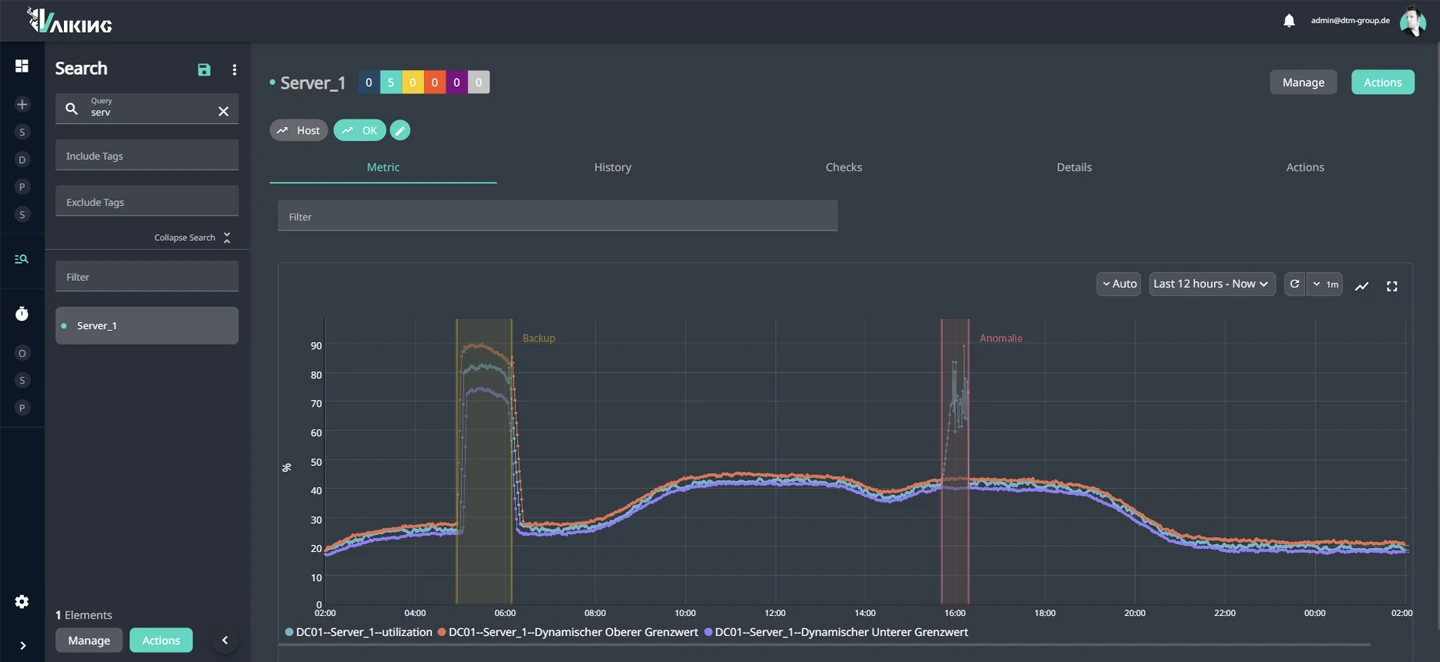
ALERT NOISE IS NOT JUST AN EFFICIENCY PROBLEM. IT INCREASES THE RISK OF MISSING RELEVANT EVENTS.
When twenty alerts fire every day for backup jobs and maintenance spikes, teams adapt. Alerts get ignored. Acknowledged. Without checking.
And when the real incident arrives right then, between a backup alert and a maintenance window, it gets lost in noise. The problem is not too little monitoring. It is too much noise for too few real signals.
CRITICAL ALERTS NO LONGER GET LOST IN NOISE.
Critical alerts no longer get lost in noise
Seasonal load peaks, maintenance cycles and recurring operational patterns are recognised as normal. The AI Module learns which correlations between server load, cooling capacity and energy demand are typical for your environment. What remains: genuine deviations.
Outages visible before thresholds are breached
CPU load, temperature and energy demand are evaluated together, not in isolation. The system detects deviations before individual limits are exceeded.
Predictive maintenance
The system recognises patterns in time-series data that indicate impending failures.
Capacity planning
AI analyses inform capacity decisions. The system evaluates not only what is currently critical but also foreseeable bottlenecks.
Prioritisation becomes reliable
When the team responds, the trigger has been validated by the system, not by the judgement of an individual.
FEWER FALSE ALERTS. WITHOUT MANUAL THRESHOLD MAINTENANCE.²
The AI Module is the only module that does not react to configured limits but to what is normal for your specific operations.
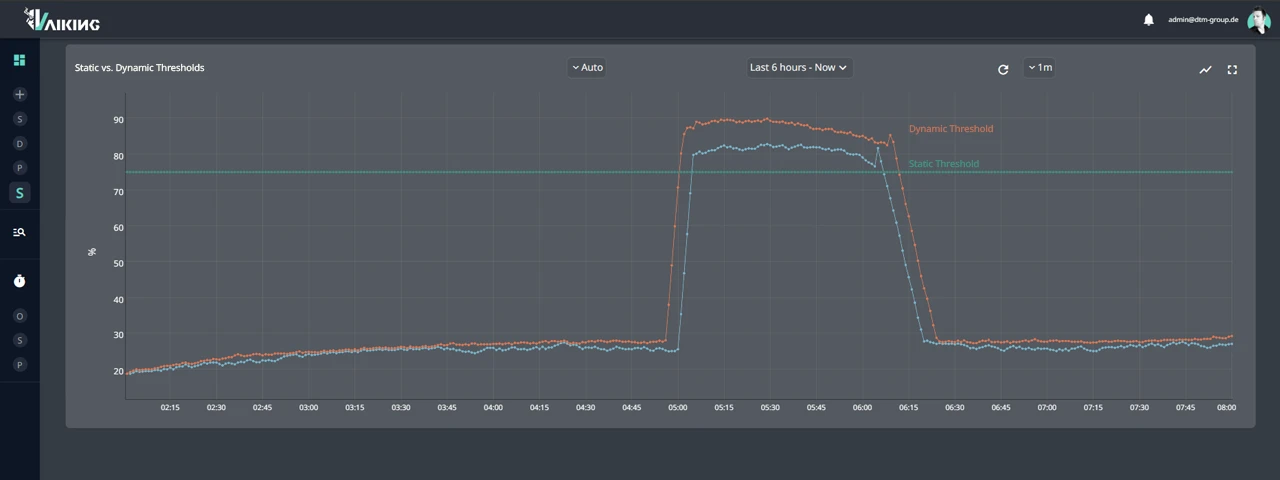
Optimisation potential from interdependent operational variables
Server load, cooling capacity and HVAC energy consumption are interdependent variables. The AI Module identifies operating points where performance remains constant and overall energy use can be reduced. Whoever evaluates IT load and building systems separately does not see this potential.
Adaptive thresholds instead of static limits
The AI Module learns which values are normal for a given host at a given time of day and season. Seasonal load peaks and maintenance cycles are recognised as patterns. An alert is raised only when there is a genuine deviation from the learned baseline, not whenever a value exceeds a fixed limit.
Every detection with a reason
The dashboard shows for every AI detection why the system classified a deviation as an anomaly. Confidence score at metric level. No model output without context.
² Dynamic AI thresholds: protected by registered utility model.
NO BLACK BOX IN CRITICAL INFRASTRUCTURE.
Every detection is accountable
What the system has classified as an anomaly can be justified. Confidence score at metric level, reasoning directly in the dashboard. No model output without context.
Own models, trained on your data
No external AI services: no OpenAI, no Azure AI, no cloud API. Models are trained on your historical operational data. On-premise or in the dtm-owned data centre.
Six years of testing in own data centre
The AI Module was tested for six years in the 4.4 MW research data centre in Sweden before being deployed in customer environments. Not in a lab. In live operations, under real load conditions.
Can be switched off without affecting monitoring
The AI Module is an optional add-on. The base Monitoring runs independently. Vaiking deploys AI only where measurable value can be demonstrated.
FROM ANOMALY TO ACTION: WITHOUT MANUAL INTERVENTION
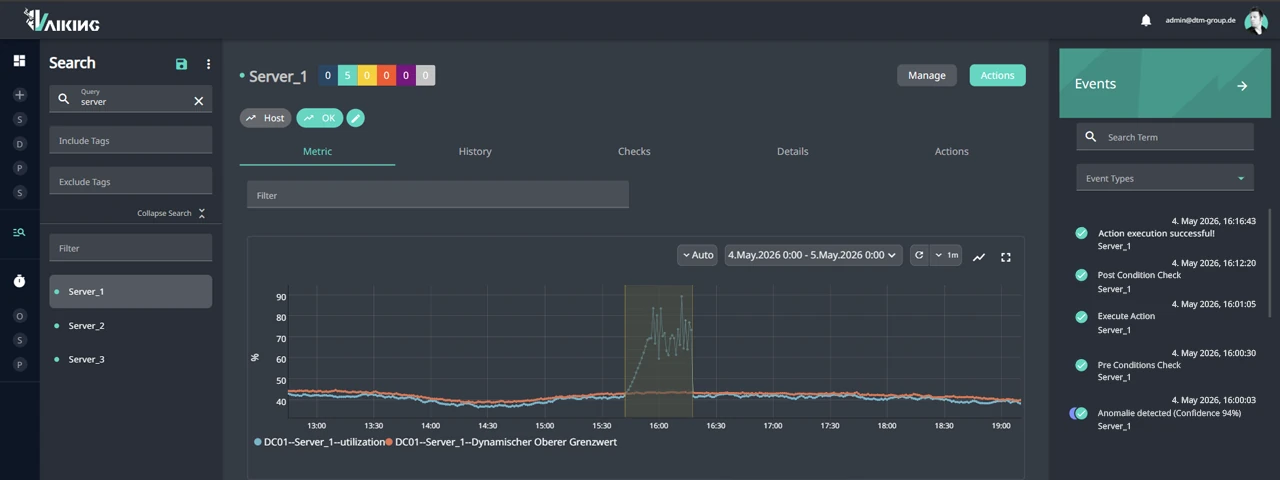
A host shows an unusual correlation: CPU load, chassis temperature and energy demand are rising together. Not a single outlier; a pattern.
KI: Confidence score sufficient. Anomaly confirmed.
PRE: Resources on neighbouring host available. No maintenance window active.
EXEC: Load shifted to less utilised host.
POST: Target state reached. Anomaly resolved.
No additional ticket. No unnecessary escalation. Fully logged.
That is the closed loop: AI detection directly into automation action, over the same data stream, without a media break.
¹ Requires Automation Module.
FIRST RESULTS WITHIN DAYS. NOT MONTHS.
The AI Module is layered on top of the existing Vaiking Monitoring data stream. No additional infrastructure, no separate system. First usable results emerge within days. Seasonal accuracy grows with the historical data basis. That is why the numbers are reliable when they come.
For a fully automated control loop: combinable with the Automation Module. AI detections are used directly as triggers: detection, decision and action without a media break.
PARALLEL TO EXISTING ALERTS. INCREMENTALLY ACTIVATABLE. CANCELLABLE WITHOUT SYSTEM INTERVENTION.
Existing alert rules remain active
AI evaluation runs in parallel with configured threshold alerts. No existing rule is changed or disabled by the AI Module. AI detections complement alerts; they do not replace them.
Stepwise activation at your own pace
The team decides whether AI detections are initially only made visible or immediately used for prioritisation. Automated escalation is enabled separately. Observe results before delegating responsibility.
Models on your data, no external dependency
The model trains exclusively on your historical operational data. No comparison with other customer systems, no shared data basis. The baseline is your operations.
Decision is reversible
The AI Module can be switched off without system intervention. All configured threshold alerts remain active. The base Monitoring is at no point dependent on the AI Module.
YOU KNOW WHAT THE AI MODULE DOES. NOW WE ASSESS WHETHER IT FITS YOUR MONITORING.
We check whether alert noise and prioritisation in your setup can be solved with the AI Module.